…from the Lower Palaeolithic to 1500
Right. Shall we get started.
The biggie of the Lower Palaeolithic, even bigger than fire, was the invention of language which, until recently, seemed to be quite a good idea. It was also around this time that Homo heidelbergensis started woodworking construction, in what is now Zambia. This is the era when humanity went from being eaten or trampled by massive animals to having conversations in a house. Quite the progression.
Timings are place can be pretty vague when you are talking about pre-history, what with the lack of a history, but the current consensus is that during the Middle Palaeolithic someone invented beds (in South Africa?) and some invented representational art (the earliest of which has been found in Indonesia). The Upper Paleolithic brought us shoes (China) and bread (Jordan). I realise I’m not exactly recommending things you don’t know about yet. Give me a millenium or twelve.
Once you have invented bread, you need to invent cheese and, eventually, somebody did, possibly in Poland, or Croatia, during the Mesolithic era. Meanwhile, in Babylonia someone invented plumbing which, in the Bronze Age, would lead to the invention of the toilet. Writing began to evolve in Sumer and Egypt and people liked it. By the Iron Age there was so much of it that someone in Ninevah decided to put it all in one place, and invented the library. In Carthage somebody invented the crank which would set off a chain of events that would culminate in Jason Statham trying to fix a microwave while keeping his heart rate above eighty beats per minute.
It feels like I should have given Classical Antiquity more than a paragraph but I’m not going to because everyone else bangs on about it so much. Instead, let’s reduce it to a mosaic of a chicken, which is excellent, and my opinion that if you are going to read Plato, The Republic is by a wide margin his worst book. Give Meno a go instead.
The 6th Century was a good century for buildings, in particular the Songyue Pagoda and the Mausoleum of Theodoric. The 7th Century gave us The Dream of the Rood and the first instance of finite difference interpolation, by Indian mathematician Brahmagupta, who also described gravity as an attractive force. The 8th Century brought the works of Bede and a panel with Brother George the Scribe on it of which only this fragment survives.
Let’s go back to buildings for a century. The 9th brought with it the Mosque of Ibn Tulun in Egypt and Borobudur temple in Indonesia. On a smaller scale, the 10th century gave us this bowl, which is gorgeous. It also gave us the Atlantean Figures at Tula, Mexico. The 11th Century gave us Beowulf, which people should stop trying to make films and tv series of, because its narrative structure is a mess, but nevertheless is a banger, poetry-wise. We also got three St Mark’s Basilicas, the last of which they kept, because it is lovely.
The 12th Century was all about Hildegard of Bingen, who, when she wasn’t writing works on botany and medecine, or pretending that all her thoughts came from a divine source so that she could navigate the patriarchy, was composing music that hardly anyone could hold a candle to for the next five hundred years. I’m also a big fan of The Rolls Plaques, and if you like pictures of people hanging out with weird animals, you might be too.
The 13th Century was probably no more violent than the preceding or following centuries, but the fighting then gave us Restormel Castle, which I think is probably the best castle, and the Laxdaella Saga. Proper love an Icelandic saga, me.
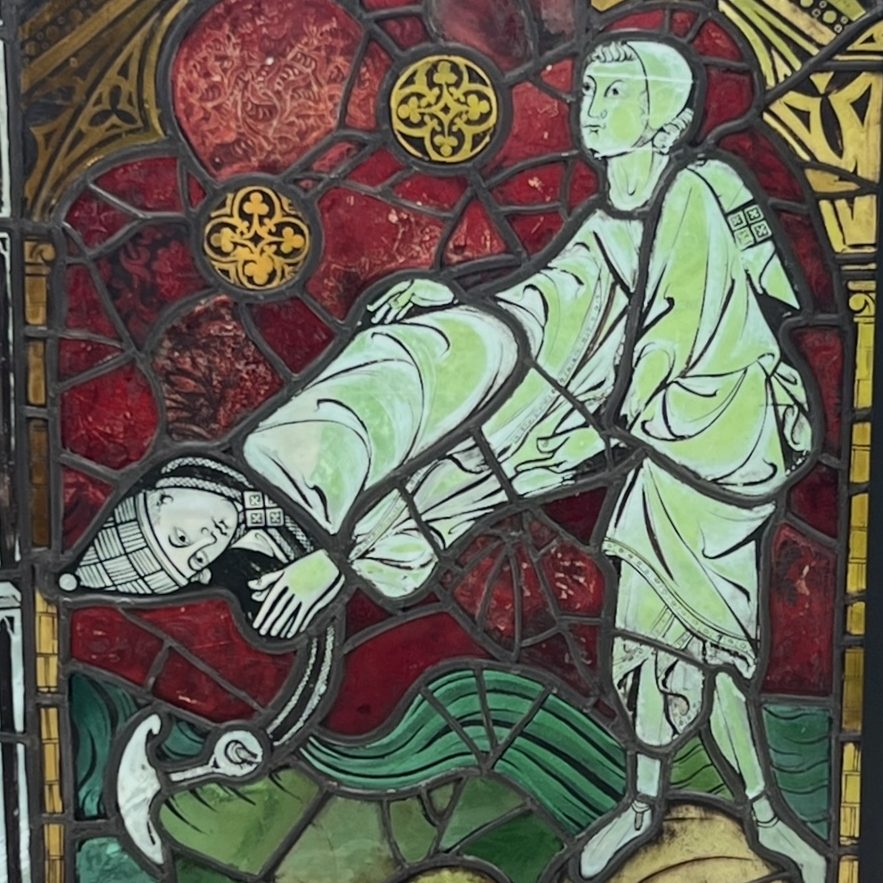
For short story fans, the 14th Century is kind of a big deal, as it was when Giovanni Boccaccio wrote The Decameron which still slaps after almost seven hundred years (The G.H. McWilliam translation is gorgeous). And who could deny the joy of St Nicaise, Bishop of Rheims being thrown into the sea represented in stained glass? Not me, which is why I made it the featured image of this post.
From the 15th Century, may I recommend this portrait of Ming Xuanzong and a carving of an angel from the church of St Michael, Lancashire in the Burrell Collection in Glasgow. I can’t find a photo of it on their website but there is an excellent one on this blog, which also gives you some information about the museum.
Next week will be a quick look at the period from 1501 to 1699. Something to look forward to.
 Benjamin Judge's judgements
